
Pen on paper
Rediscovering a life of letters

A few days ago, I received a postcard from a dear friend in Japan. It had been sent from Shimoda on the Izu peninsular and depicted a panorama of the bay and three views of the hot spring baths at the Hotel Yamadaya. On the back, a warm and thoughtful message filled the space beside my address, and in the top right-hand corner two ¥50 stamps had been pasted, each of which depicted a mandarin duck. The postmark was barely visible but my friend had added Air Mail to England in red pen, which led me to wonder, did she keep this pen in her bag ready for such occasions?
The card had arrived out of the blue. No ping or pop-up notification announced its arrival, just the hurried scrape of a letter box. I didn’t even rush to check the delivery. After all, it’s rare these days to receive what I still think of as ‘real’ mail. Printed items, when they come at all, consist largely of bank statements and the odd Amazon package so this arrival felt special. I took my time looking at the card, turned it over in my hands absoring every detail. After all, it may be only postcard I receive this year. Once satisfied, I propped it against my desk lamp, where it now sits in my peripheral vision while I work.
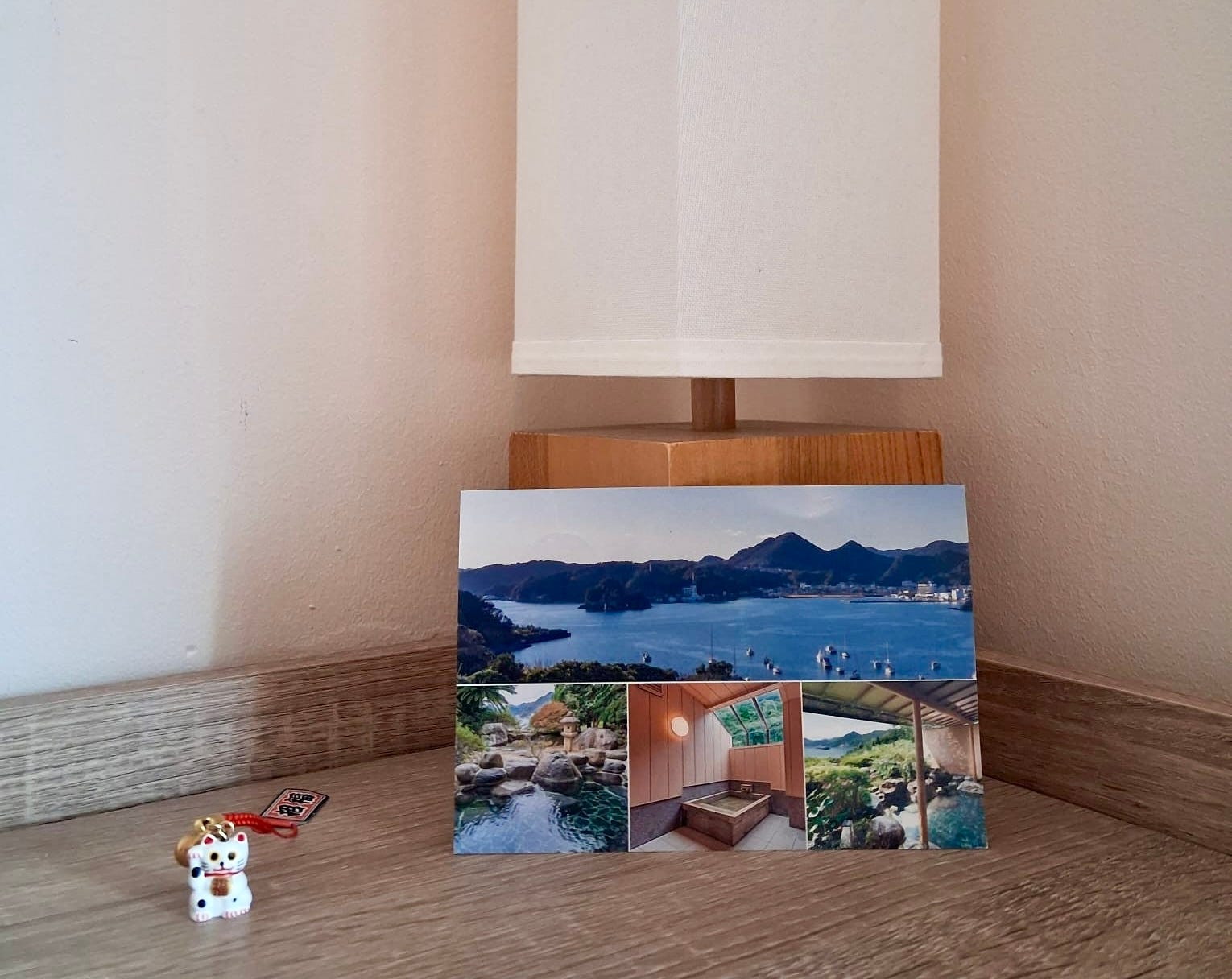
Postcard from a friend in Japan, showing Shimoda
Of course, it’s just a postcard, an ordinary postcard, and yet somehow it feels remarkable. Which is strange really, for my living spaces were once filled with cards - balanced on shelves, pinned to boards, even stuffed in drawers; scenes from far-flung countries or quirky vintage photos or ink-brushed calligraphy. Each a reminder of the fact that someone had taken the time to craft a message, to think of me. As if the old cliché it’s the thought that counts really were true. But then I too sent hundreds of cards over the years, dropping them into unfamiliar mailboxes in countries I may never see again. Letters, too, and aerograms, delicate pages covered with my forward-slanting scrawl, the text punctuated by occasional drawings or arrows to notes in the margins. Some contained photos or inserts like bookmarks, flyers, origami or adverts snipped from newspapers. All were written on carefully chosen paper and sealed with little stickers or an inked stamp.
I know this because my mother kept every piece of correspondence I sent home to my family, over thirty years of ‘air mail from Japan’ (and quite a few other places), stored in a foolscap file that she returned to me last year. As I look through those letters now, I feel like an archaeologist unearthing a distant way of life. Did we really write so often, using such a variety of stationery? Were stamps always miniature works of art, depicting nature, culture, historic buildings? And then there are those funny little scribbles where I’ve attempted to write the katakana or kanji for ‘England’ or added instructions for post office staff! I have to smile.
Without these letters, I would have forgotten the addresses of the little flats and houses I lived in during my time in Japan. Gone, too, would be memories of my daily comings and goings or more dramatic events such as the time two towels fell onto the gas heater and were in flames!. On 16th January 1991, I find myself describing an evening chatting (in Japanese, our only common language) to two Argentinian sumo wrestlers. On the 23rd December 1992 I was ploughing through the classic Tale of Genji, while on 23rd June 1994 I am having dinner in town and then going to see the Alvin Ailey dance company (a special treat!). So many exclamations and parenthetical comments, such a mix of practicality and wonder, it’s as if all life is jumbled together on the page. And I’m so grateful that mum didn’t throw them away.
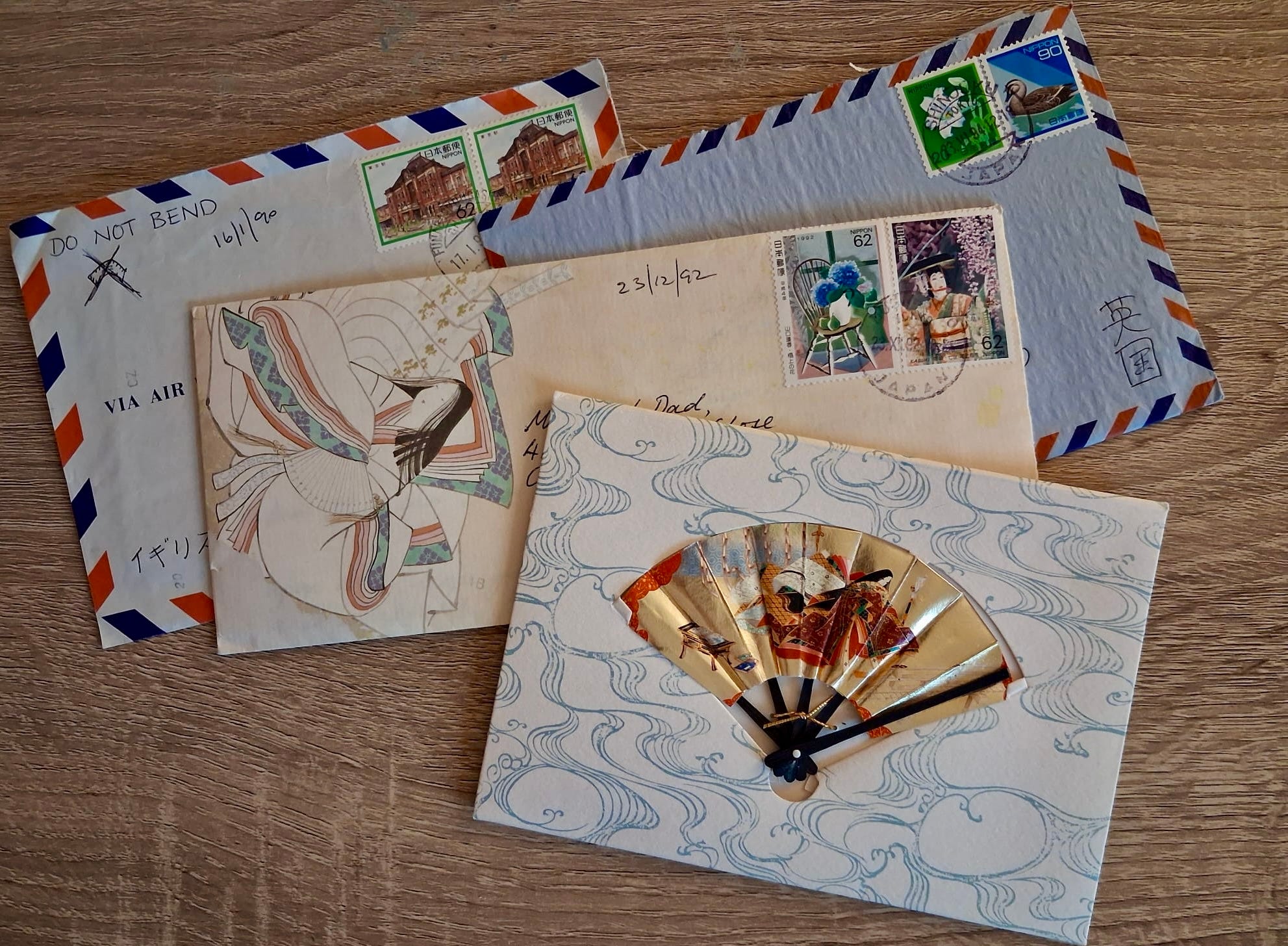
Cards and letters frm the late 80s and early 90s
And yet there’s a sadness too. These letters and cards, written with such enthusiasm, now feel like relics of a lost world, a world in which we seemed to have so much time and took it for granted that we’d create with our own hands, our own minds. Each item was crafted with just a little effort. First, one had to shop for stationery and, given that I lived in Tokyo, hours could pass while I browsed department store aisles or specialist sellers. Then I had to consider the content, sometimes even plan it out, for writing by hand meant that any mistake would ruin a whole sheet of paper. Care was required, care and time, as I considered word choice, spelling, handwriting. Perhaps there was something else I needed to add, to illustrate an event or idea that was hard to explain? And how about stamps, did I have some in a drawer, or was a trip to the post office necessary? Finally, though, I’d seal the envelope, decorate the pointy end of the flap and carefully inscribe addresses front and back.
All of which might take hours. Or even days.
Put simply, communicating with family and friends was a process fraught with friction. It was slow, it required thought. And yet it was that very friction that created meaning, that showed care and attention. Perhaps I could have simplified the process but it never occurred to me to do so. Writing cards and letters was a pleasure, not a chore.
Then email arrived.
I don’t remember the first year in which I used email but it was probably late in the 1990s. What I do remember is the sense of astonishment at its very existence. At the tap of the keyboard a typed ‘letter’ would arrive thousands of miles away. Instantly. In the days before video calls and smartphones, this was life-changing. Suddenly we could communicate with loved ones almost in real time. Better still, we could ‘attach’ images and documents, which for some reason felt more exciting that popping something into an envelope. I was hooked.
Not that I gave up letter-writing, not then. At that point, email still felt a bit too impersonal, and anyway I loved writing by hand, adored stationery and stamps. And perhaps because I’d been writing letters for so long, I simply continued sending them - from Japan to the UK, from the UK to Japan, and then to France, Thailand, New Zealand, the USA. Anywhere I had friends or family.
But time passes, life changes.
With the arrival of smartphones and their messaging apps, it has become all too easy to default to a quick WhatsApp, Line or Messenger - a few words, some pictures, an emoji. Like everyone else, I’ve embraced the tech, even if such messages do feel a bit cursory. There is a lightness, a cuteness to them when compared to handwritten cards. They seem to require little in return and half the time you can simply send an emoji or gif. Yes, digital messages seem to live in the moment, with no concern for the passing of time. And they are easy, oh so easy, to send.
But what if convenience is not all that matters?
What if speed is overrated?
The truth is that digital messages, so easy to dash off, seem to lack something, their coded simplicity somehow less authentic, less beautiful. And the fact that they disappear into a ever-scrolling inbox or ‘conversation’ means that, ironically, they are less permanent than paper. Where are the emails I sent ten years ago? Twenty years ago? Nowhere to be found. Yet recently, sorting a box of my 93-year-old father’s belongings, I found three letters I’d written him when I was eight years old. They are sweetly poignant (my parents had divorced a year or so earlier) and speak of a child’s concerns.
This is new note paper. I got it yesterday. We went to Newmarket.
I also bought an eraser. It is a JUMBO eraser. I miss you.
Lots of love, Alison.
On the back of the envelope is a gold star and an underlined message: Please open now. My heart breaks a little seeing these. The careful handwriting, the yellow paper with a squirrel design, the 31/2 pence stamp, the postmark for Newmarket Races, all tell a story impossible to convey through an email or message.
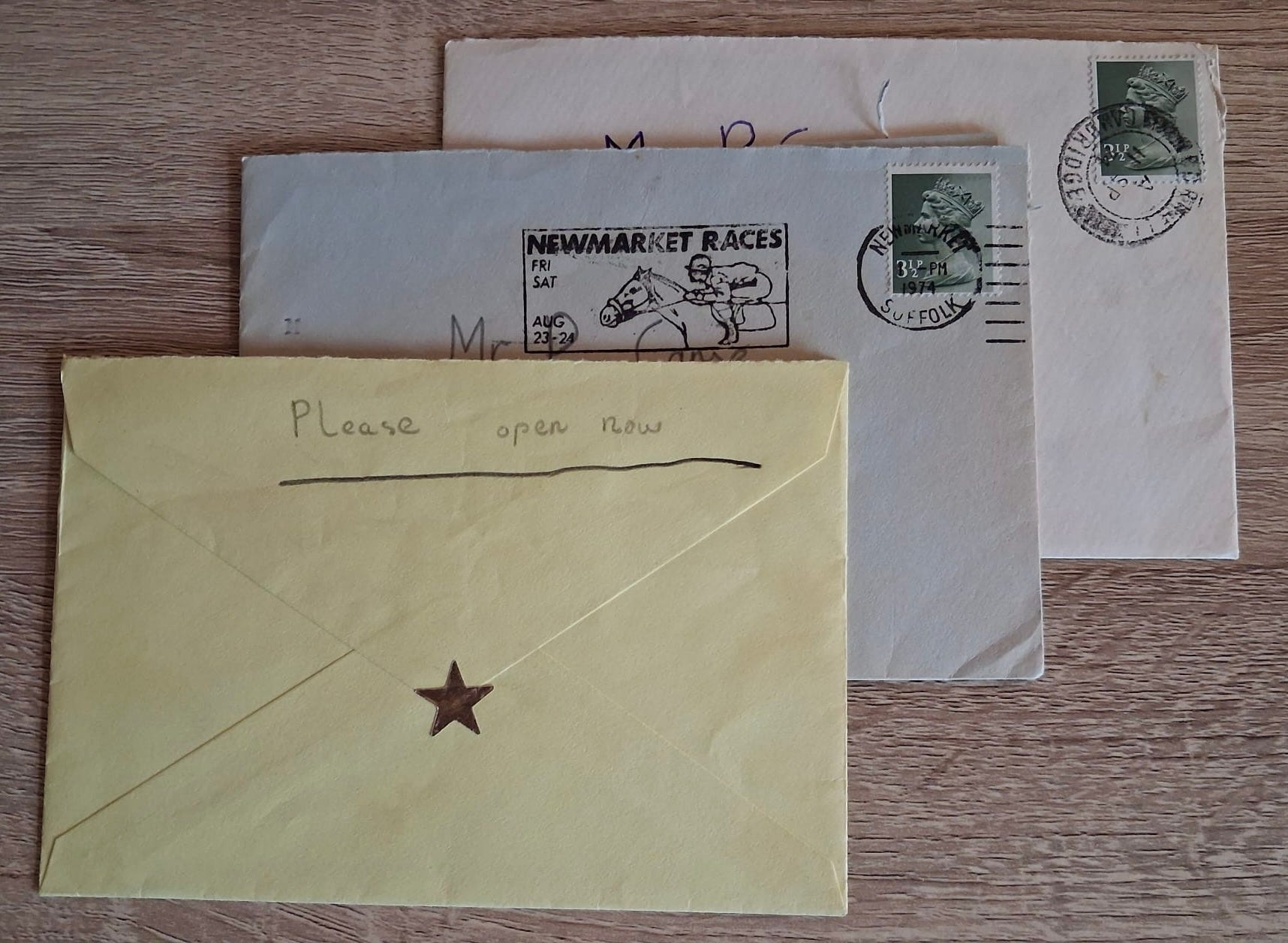
Letters sent in the early 70s
There have been other stories, other letters, all evidence of a unique life lived. Three in particular remain with me.
In the first I am fourteen years old and have started exchanging letters with a girl in South Korea, stories of our lives scratched onto delicate air mail paper with unreliable pens. She sends me photos, which I peer at for long minutes, trying to ‘read’ a life lived 6000 miles away. How did I find this penfriend? Was there an ad in Jackie magazine? Did she want to practise her English (for certainly I knew no Korean)? I have no answers to these questions. All I know is that those fragile envelopes with their stamps bearing flowers and fabric patterns were like treasure to me, currency from a wider world that I was determined, one day, to visit.
Fast forward to university and I’m navigating an unfamiliar world of privilege. As I struggle with self-doubt, my sanity is sustained by almost daily correspondence with my best friend, Corinna. She is two years younger than me, still at sixth form, but we tell each other everything. Our friendship is innocently passionate, in the way of young women, and we dash off hastily scrawled (but carefully chosen) cards and letters. We stretch language to fit our hearts, trying to describe secrets and doubts. We collect quotations, aim to be witty. Later I wonder what, if anything, post office staff made of these outpourings of emotion!
In the third memory I am twenty-three, a member of the anti-apartheid movement. Every month I exchange letters with a single mother in South Africa. I have a job now, earning enough to share what feels to me like wealth so I send postal orders too, a little something to help out. Again, I cannot recall how this came about, but I can still picture the letters that made their way back to me, and the sun-bleached photo of a woman and her children standing in front of a tin-roofed shack.
The years that followed brought new friends, new lovers, and long stretches away from my family in Britain. The internet and smartphones were things of the future and although I had a landline, the high cost of overseas calls meant I used it just once or twice a month. Letters, however, were different, and I wrote to my family at least twice a week. With friends too, correspondence was frequent. Every time one of us travelled we’d exchange postcards or letters, keeping ‘in touch’ in a truly tangible way, knowing we held in our hands the very envelope they had touched. Hundreds of envelopes, as many cards, the senders identified immediately by their handwriting, which not only spoke of their character but also hinted at their current mood. There was something unique about each letter, something tender that made one handle it carefully. Unconsciously perhaps, it could be experienced as fragment of the person themselves.
These days I find myself missing that exchange of letters, missing the slow and careful labour of letter writing. I even miss the wait for a response (which, to be frank, could take weeks). Somehow, it made communication feel more vulnerable – what if the letter got lost? – and more meaningful. The pages people write are the product of craft and care, two precious human traits. They have created connections between millions of people over hundreds of years and, in many cases, may still be read.
Are we willing, I wonder, to lose that?
Thinking about this recently, I realised that all is not lost. After all, beautiful stationery still exists (there are links to some sellers below), and most of us can, if we really wish, find time to slow down and gather words we’d like to share. It’s true that postage is no longer cheap (at least from the UK) but it’s certainly more affordable than the monthly phone contract needed to send digital comms.
That postcard from my friend has lifted my spirits and set off a whole train of happy memories. Inspired, I’ve just bought new stationery from Under the Rowan Tree; just a few cards and stickers but it’s a start. And who knows, perhaps my own efforts will bring equal happiness to my old friend far away.
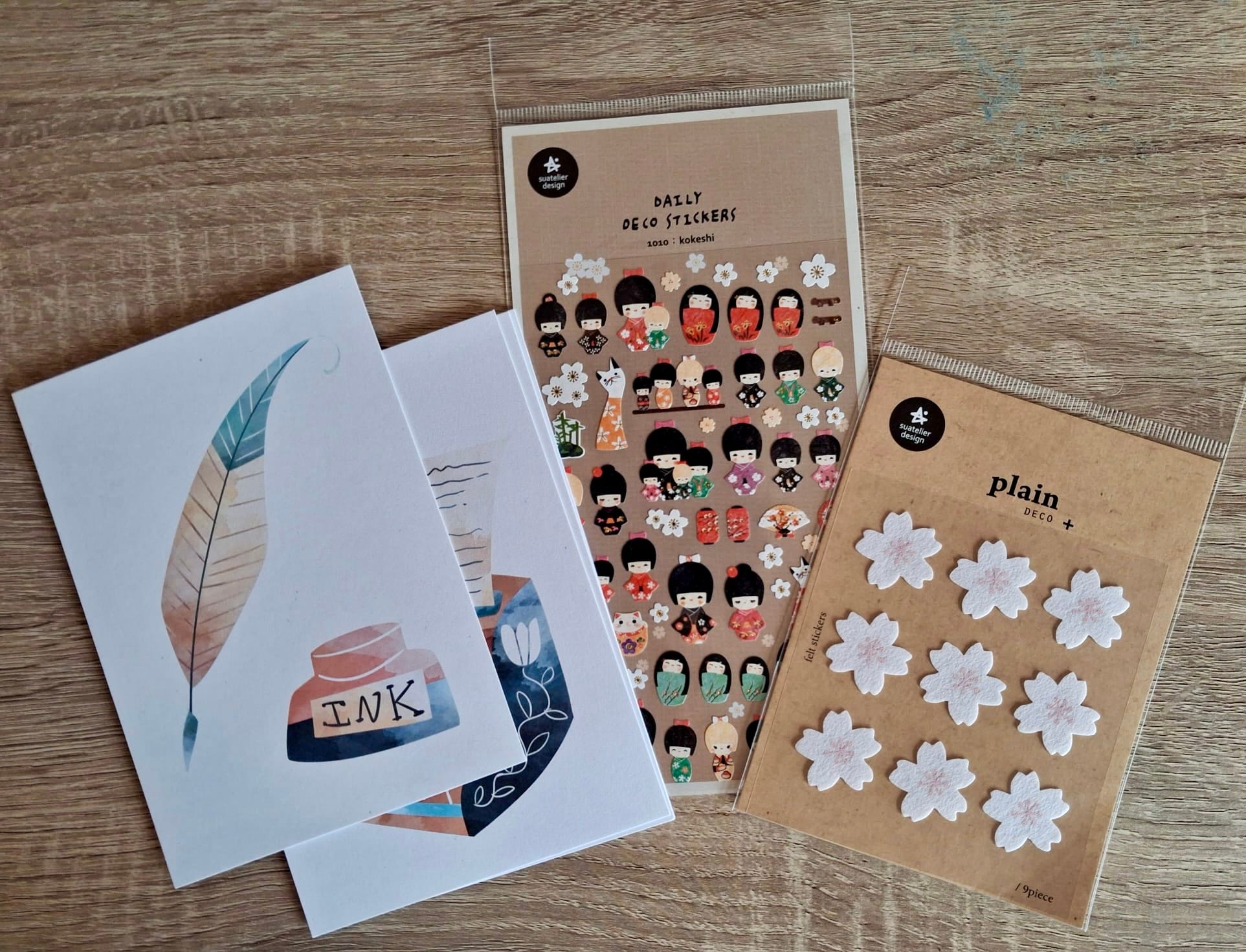
Stationery from Under the Rowan Tree
Some ideas for where to buy letter-writing materials
https://undertherowantrees.co.uk/collections/letter-writing-supplies
https://www.thejournalshop.com/
https://www.kokuyostore.com/en_GB/stationery/stationery-letters/
https://www.ryman.co.uk/stationery/pads-books/writing-paper-pads
Hi Alison. This was such a beautiful article and though we have lived different lives, I feel like it brought back similar nostalgia that you may have felt. My eyes got a little watery when I saw the letters you sent to your grandad. It's different, but it reminded me of the Otoshidama bukuro my grandparents gave me every year when I was a kid, and I've kept every single one of them. I dont know if its the hand-written words or the stamps, but your article reminded me the wonderful feeling of receiving a letter, and made me think I should take time to write some soon. Thank you so much Alison. Loved it so much.