
With a little help...
Thoughts on choosing human connection

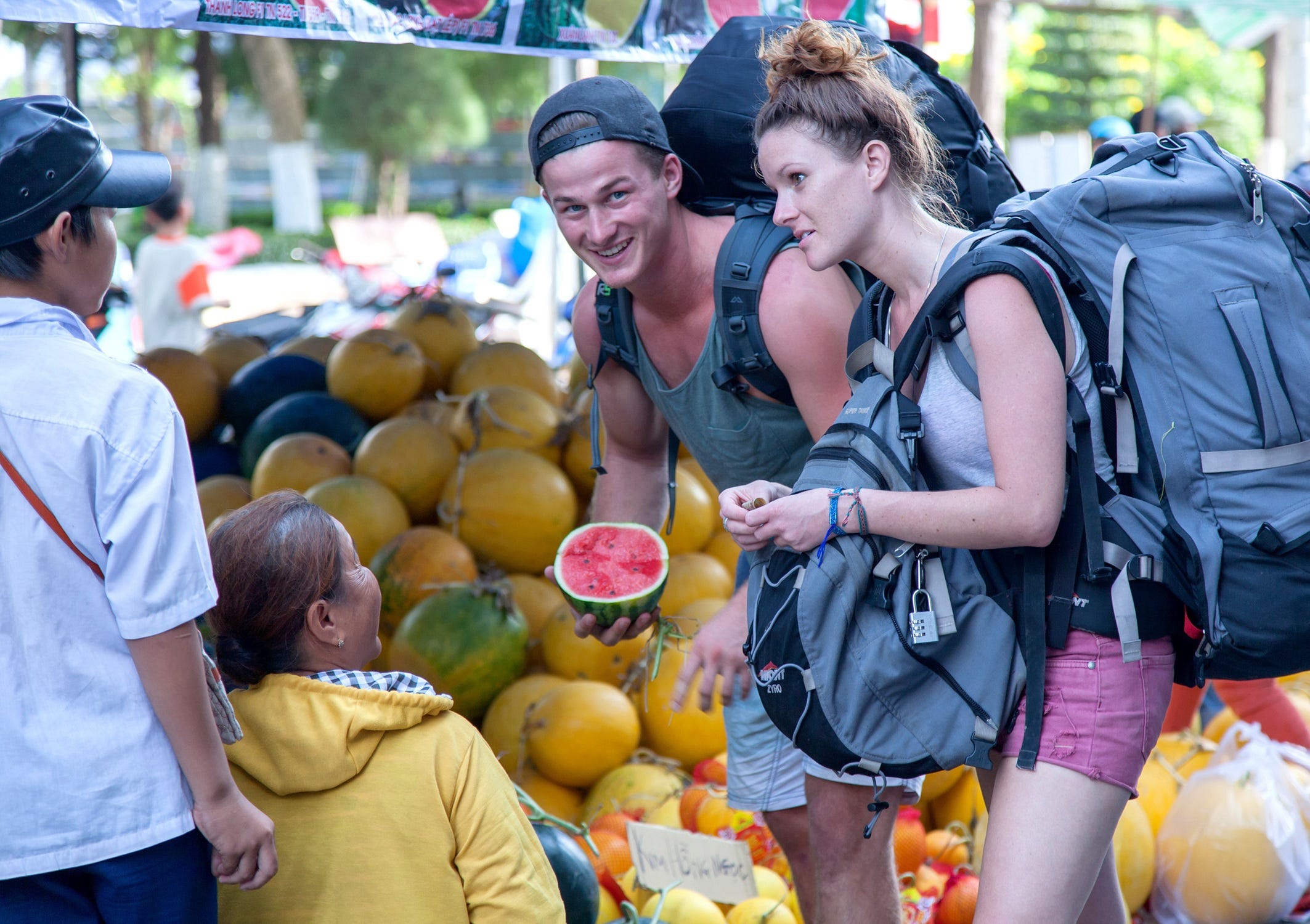
In April and May this year, I was one of almost 6 million people in the UK who watched the BBC series Race Across the World. You may have heard of it, you may have a version in your own country. But in case you’re wondering what I’m talking about, Race Across the World involves five teams of pairs travelling between two distant points without the use of planes, credit cards or mobile phones. Instead, they receive the cash equivalent of the airfare to that destination. Then for the next fifty days or so, the competitors – who could be siblings, best friends, parent and child or couples - stretch their physical and mental skills as they journey across unfamiliar lands.
Their goal?
To be the first team to reach the final checkpoint and the prize of £20,000.
https://pixabay.com/photos/vietnam-tourism-watermelon-backpack-1691599/
While on air, it was the most watched programme in the UK. No surprise really, as it has all the ingredients of success: engaging characters, gorgeous landscapes, challenge, risk and, of course, competition. For me, though, the magic lies in this:
Without phones and on a limited budget, participants have no choice
but to ask for help.
Their very success relies on them admitting their ignorance, overcoming nerves and speaking to local people.
Where is the station? How can we find accommodation? Will you give us a lift?
And many competitors struggle with this. In series 2, episode 4, for example, young siblings Dom and Lizzie need to find transport out of Lima. Standing in the main plaza with the clock ticking, Lizzie freezes. ‘I don’t know how to approach people,’ she admits. Finally, though, with her brother’s encouragement, she plucks up the courage to ask someone for help. The result? A friendly conversation and smiles all round.
Once, of course, this was how everyone travelled - speaking to locals, poring over printed maps, getting advice from guesthouse staff. My own travels involved many such encounters, moments that remain with me still:
Tokyo, 1988, a group of students helping me buy a ticket in Shinjuku station, then leading me by the hand to the very platform before bowing me on my way.
Thailand, 1998, heatstroke in Chang Rai, a guest house owner bringing me freshly squeezed orange juice, salted in the Thai style for rehydration.
Marrakech, 2015, sick (again!), an elderly Berber woman chatting to me in French almost as broken as my own, keeping up my spirits as she hung freshly-laundered sheets across a rooftop.
Tokyo again, 2011, a day after the Great Eastern Japan Earthquake. Half-stunned, I walk around the neighbourhood before pausing outside a facility for disabled youth. A volunteer steps out, I ask if everyone is OK, and we chat a while. Then he pops back into their bakery and brings out a loaf and two buns. We baked these for today’s festival but now it’s cancelled – please, take them.

Even now my heart cracks a little as I recall these encounters.
Which suggests, perhaps that like most people, I don’t expect them. Sam, a young contestant in episode 2 of Race Across the World, sounded genuinely surprised when he discovered that, ‘you can rely on the kindness of strangers because when you do, they are there to help’.
Modern life, technological life, so often reinforces a sense of alienation, of solitude. And yet human beings are made to connect. Our success as a species (for good or for bad) is based not on our strength or even, perhaps, our intelligence, but on our ability to work together. To be helped and to help others.
I remember a visit to Kôchi on the island of Shikoku back in the spring of 1989. It’s a mild afternoon and I’m passing an old bookshop when its elderly owner – dapper in a tweed jacket and beret – dashes out and stops me.
Please to come in.
I’m too surprised to refuse. Instead, I follow him as he leads me to a counter at the back of the shop, upon which lies a copy of Virginia Woolf’s ‘To the Lighthouse’. A small paper bookmark protrudes from one of its pages.
This phrase, some poet’s words, you know it?
Did I know it? I might have done. After all, I’d not long completed a degree in English literature. But the truth is, I can no longer remember. Instead, what remains is the echo of this encounter, and a sense of how much has changed. Today, if an elderly bookseller wished to check a quote, he would no doubt type it into Chat gpt. Thirty-seven years ago, he waited patiently for a foreigner (a rare site in those days) to pass his shop. A slow process, no doubt, but also a human one, relying on chance and communication. So that even now I treasure this memory of an elegant stranger asking me a question about – of all people – the writer closest to my heart.
Are we losing such connections, I wonder, such opportunities to help each other?
Wherever we go now, in shopping malls and train stations, airports and even restaurants, technology is gradually replacing human contact, handling problems that were once solved by people. Those who promote robotics and AI argue that these tools enhance efficiency, provide 24/7 service and support human staff. Most businesses believe they save money across their organization, and it would be hard to argue with this.
And yet I’ve noticed something.
People don’t always want to be helped by machines.
At supermarkets across the UK, many customers - particularly those over 40 - still choose to queue at a ‘real’ till rather than use the self-service machines. Does this save them time? No, not usually (though the machines are not infallible). Instead, what it offers is a chance to chat, both to fellow shoppers and the cashier, a chance to say things like you go ahead, I’ve only got a couple of bits or I see you’ve got your barbecue stuff; those burgers are lovely or even, in local stores like the one near me, how’s your mum doing? For those who live alone, who are elderly and may have lost their life companion, these small interactions can be a lifeline, the only human contact in a day. And for all of us, such moments offer the chance to show our best selves, our ordinary, authentic selves.
To help and be helped.
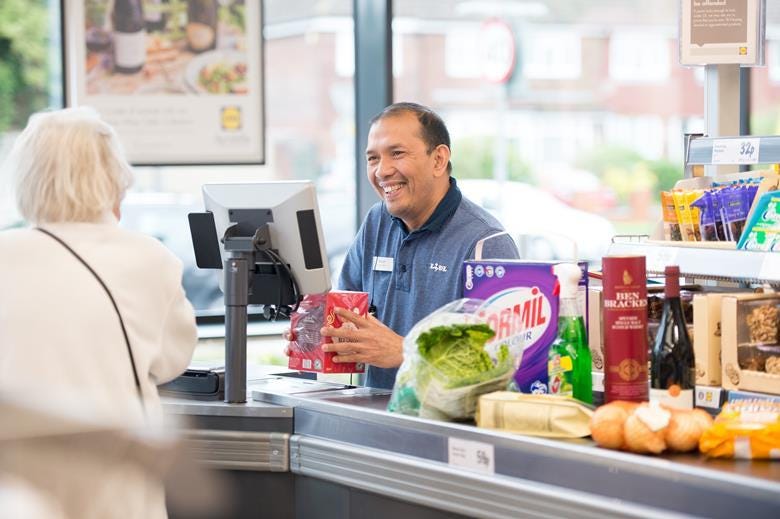
Photo courtesy of The Grocer (2025)
In a 2024 article, Evelyn Rossett and her colleagues1 discovered that ‘helping others could be an appropriate intervention for those who are the most in need.’ In other words, although choosing self-care and adherence to your own values is important, focusing on other people’s well-being can greatly benefit our mental health.
I wonder, is this because thinking of others takes us out of ourselves, distracts us from our obsessions? During one of the darker periods of my life, it was my work as a teacher that kept me afloat. In class I had no choice but to put aside my worries and focus on my students. It wasn’t always easy but each and every lesson left me feeling a little better.
At the same time, allowing others to help us is equally important.
Zen monk, Shunmyô Masuno, in his book ‘Don’t Worry’2, says, when you need support, instead of carrying the burden on your own, it’s better to ask for help.
He acknowledges that it can be hard to ask for assistance but urges us to be open and honest…and put our pain into words. Then, he assures us, someone will be there to lend a hand. I feel he is saying that regardless of whether we are offering or accepting help, it is the interaction itself that generates a moment of warmth, a chance to feel better about who we are and to gain strength from our shared humanity.
I was thinking about this recently when I parked my car in a nearby town. The council have installed new ticket machines there, ones that require you to input your registration number. As a result, the ticket you buy is linked to your car alone. A reasonable system, except that in the past, if you left the car park before your allocated time limit, you would offer your ticket to a driver who’d just arrived so that they could use the remaining hour or so. A small gesture and I can see why the council might want to stop it, but it was a way to help and be helped. A friendly little moment of connection.
As I stood there, crisp new ticket in hand, an elderly lady approached. She frowned at the machine, then turned to me. Do you know how these work? They’ve changed the bloomin’ things. I walked her though the steps and we chatted for a while, having a cheerful moan about the ways of the world.
And then it occurred to me, we might not like the new ticket system, we might have wanted to pass on a still-valid ticket, but change had not stopped us connecting and helping.
So I guess it’s up to each of us to create small moments of human interaction, to choose to step forward and engage with those we meet rather than peer at yet another screen. Yes, the bots can provide lightning-quick answers, can make troublesome daily tasks far more efficient but if we wish to retain our humanity, it is to other people that we must turn - to help and be helped.
References:
Rosset, E., El-Jor, C., Kotsou, I., & Shankland, R. (2024), Getting outside of ourselves: Towards an other-oriented model of psychological health. International Journal of Wellbeing, 14(2), 3561, 1-19. https://doi.org/10.5502/ijw.v14i2.3561
Masuno Shunmyô (2022), Don’t Worry: 48 Lessons in Achieving Calm. UK: Michael Joseph
Originally published in Japanese as 「心配事の9割は起こらない」